On 7 October 2023, a barbaric terrorist attack shook Israel to its foundations. This day will go down in history as a memorial to hatred, madness and inhumanity. Thousands of innocent civilians, including women, children and the elderly, fell victim to the bestiality of a cruel attack. Entire families were wiped out, women brutally raped, men and children abducted and taken hostage. In the midst of these horrific atrocities, however, the question arose not only of Israel’s response, but also that of the international community, in particular the United Nations. And what was the UN’s response? A complete failure – a moral betrayal of its own principles.
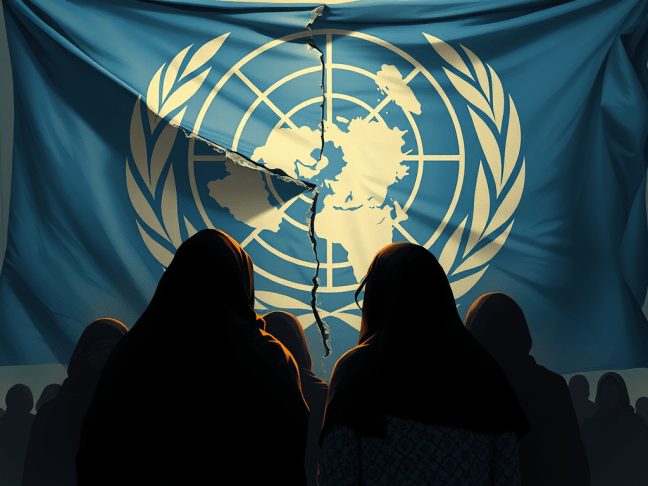
The United Nations, which since its founding has seen itself as the guardian of humanity, justice and peace, experienced a moral bankruptcy on this day that has not only shaken confidence in its ability to maintain peace, but also calls into question the very foundation of its existence. Not only did they fail to firmly condemn the terror against Israel, but they also failed to recognise the victims of this crime in their full significance.
There are moments when the global community is faced with a decision that reveals the true character of an institution. 7 October 2023 was one of these moments, and the UN failed this test in a terrifying way.
The rape victims and the UN’s silence
The UN’s response to the reports of raped women – women who had been abused in the most horrific way – was particularly harrowing. These reports became an essential part of the response to the terror, and yet the response of the international community, especially the United Nations, was by no means characterised by empathy or compassion. Rather, the silence was deafening. The victims of these heinous crimes, abducted, abused and raped by their tormentors, faced a wall of disbelief.
The UN, which repeatedly presents itself as the institution of women’s rights and the promotion of gender equality, refused to name these crimes and give the victims the attention they urgently needed. Instead, there were only vague statements and an incredible reluctance to take a clear stand against the perpetrators and in favour of the victims. In a world where rape is used as a weapon of war and the abuse of women in conflict is repeatedly at the centre of international discussions, the UN failed to stand up for the women who in this case were degraded and destroyed in the most horrific way.
Such behaviour is not only a failure of the UN as an organisation, but also a betrayal of women’s rights and international solidarity. At this moment, the UN should have shown itself to be an ally of the victims, not only condemning violence, but also taking responsibility for taking action against the perpetrators and offering protection to the victims. But instead it remained empty rhetoric and hesitant reactions.
The hostages: invisible in the eyes of the UN
But the victims of terror were not only the women who were kidnapped and raped. The hostages who fell into the hands of the terrorists also had to experience what it means to be forgotten by the international community. Thousands of people, including men, women and children, were abducted, often under the worst possible conditions. But what did the UN do to help them? What did it do to free the hostages or at least ensure that they received some form of support?
There was nothing. No clear call to free the hostages. No visible attempt to work towards a solution through diplomatic channels. Instead, the victims of terror had their backs turned. No political statement calling on the international community as a whole to take a united stance against the perpetrators. No resolute action against those responsible. The hostages became another symbol of the UN’s failure to stand up for those who needed it most.
The question arises as to how it can be possible for one of the world’s largest international organisations to fail so obviously at a moment like this. The hostages were not only victims of the terrorists, they were also victims of an international community that hid behind diplomatic platitudes and political games instead of facing up to the real problems. The UN, which has often provided solutions to other conflicts in the past, had no answer to this appalling situation. It failed to stand up for the hostages with all its might and to support them.
The betrayal of the fundamental principles of the UN
This incident dramatically demonstrates the moral decline of the United Nations. The organisation has betrayed its own basic principles – values such as justice, human rights and the protection of civilians from violence. The United Nations has never been a neutral body that stands idly by and watches the world’s atrocities. It was founded to confront human suffering and find solutions. But on that day, when terror hit Israel with full force, there were neither clear calls for action nor concrete help for the victims.
The UN’s reaction in the days following 7 October was more than disappointing. The words it spoke had no substance whatsoever. Instead of helping the victims, the organisation hid behind a mask of political neutrality and bureaucratic lethargy. Its supposed independence became an excuse for inaction, and the people who needed help at that moment were ignored.
It cannot be denied that the geopolitical landscape restricts the UN’s room for manoeuvre, but it cannot be overlooked that remaining silent in such a situation is tantamount to moral betrayal. The United Nations has sent a clear signal in its response to the terrorist attack: it is not about the truth, it is not about protecting human rights, it is not about supporting the victims. Rather, it is about maintaining a political status quo that is in no way consistent with the ethical obligations originally intended for the organisation.
An appeal to the international community
It is up to us not to forget these failures and to hold those responsible to account. The principles that the UN purports to uphold must not be allowed to fade further into the background when the global community is confronted with one of the worst acts of terrorism in recent history. As an international community, we must demand that the UN return to the values on which it was founded – values that affect us all and urge us to stand up for the rights of the most vulnerable.
The victims of 7 October 2023, the women, the hostages, the families who lost their lives – they deserve more than empty words. They deserve a response from an international organisation that is aware of its responsibility and is prepared to fight against terror and inhumanity, no matter who the perpetrator is. The United Nations must free itself from the silence that surrounds it and regain the moral clarity that once characterised it.
We must remember that history does not forgive us. And that the question of how we respond to suffering, how we react to atrocities and crimes against humanity, is of central importance for the future of the international community.
